

The Employers' Federation of Ceylon

"Motivate them, train them, care about them, and make winners out of them...
they'll treat the customers right.
And if customers are treated right, they'll come back."
J.Marriot Jr.

Lankan labour standards in line with ILO Conventions - EFC chief
26/07/2010
article thumbnail


Industrial peace is a key to the economic development of a country. During the global economic crisis millions of workers lost their jobs or faced curtailment of benefits they had enjoyed earlier. How will labour issues impact on the recovery and what are the new global trends in employer-employee relations?Here are excerpts of an interview with the CEO of the Employers Federation of Ceylon (EFC) Ravi Peiris, with the Sunday Observer:Protection of labour rights is better in Sri Lanka compared to other countries.We have a long history of labour protection legislations. In fact some of our legislation goes back to pre colonial times.Sri Lanka has ratified almost all fundamental conventions of  [ ... ]


EFC showcases success stories
18/05/2010
article thumbnail

The Employers' Federation of Ceylon conducted a seminar on "Success stories of companies which faced the challenges of the global recession" recently, at the Galle Face Hotel.This event was held in collaboration with the International Labour Organization(ILO) which supports contemporary issues in Sri Lanka.The seminar showcased success stories and strategies which they adopted to overcome the global recession which was 'an eye opener' to most of the organizations in Sri Lanka."We need to be proud of some of our enterprises which have demonstrated that they have the capacity and the competence to withstand the storms and sail the ship safely to the shore.These are the companies which cultiva [ ... ]


bizdirectory.lk launched
08/02/2010
article thumbnail

The Employees Federation of Ceylon (EFC) recently launched an on line business directory expanding its services to its members and facilitating business to business networking between member companies. Any international or local customer searching for a product or service featured in the business directory would have easy access to products and services of member companies, as well as other featured advertisers. The web site of the business directory is www.bizdirectory.lk.All Sri Lankan companies could list their products and services in this on line bizdirectory at a nominal cost. However, companies within the EFC membership will have special advantages in terms of advertising rates.The EF [ ... ]


Other Articles

Labour Law Reforms

25/02/2009
article thumbnail

THE SHOP AND OFFICE EMPLOYEES ACT NO.15 OF 1954  The rigid regulation of working hours and overtime is of serious concern to the manufacturing and service sectors in the context of the need to look at flexible working arrangements to adapt to market conditions. There are cert [ ... ]


26/02/2009
article thumbnail

THE INDUSTRIAL DISPUTES ACT NO.43 OF 1950 The preamble to this Act states that it is an Act for the prevention, investigation and settlement of industrial disputes. Although the preamble refers to the term “prevention” of industrial disputes, the mechanism under the Act doe [ ... ]


21/02/2009
article thumbnail

EMPLOYEES’ PROVIDENT FUND ACT NO.15 OF 1958 Once again, we annex herewith a letter sent by the EFC dated 21st April 2008 to the Hon. Minister of Labour Relations and Manpower consequent to a meeting of the National Labour Advisory Council, at which matters relating to reviewin [ ... ]


Other Articles

Lankan labour standards in line with ILO Conventions - EFC chief

E-mail Print PDF


Industrial peace is a key to the economic development of a country. During the global economic crisis millions of workers lost their jobs or faced curtailment of benefits they had enjoyed earlier. How will labour issues impact on the recovery and what are the new global trends in employer-employee relations?

Here are excerpts of an interview with the CEO of the Employers Federation of Ceylon (EFC) Ravi Peiris, with the Sunday Observer:

Protection of labour rights is better in Sri Lanka compared to other countries.

We have a long history of labour protection legislations. In fact some of our legislation goes back to pre colonial times.

Sri Lanka has ratified almost all fundamental conventions of the International Labour Organisation (ILO) in relation to labour. Freedom of association, right to join a trade union are fundamental rights in our present constitution.

Our labour legislations also promote and secure collective bargaining of employees. In fact it encourages making collective bargaining mandatory in instances where the union has more than 40% representation.

This was introduced by an amendment to the law in 1999. Sri Lanka is a unique country that has this kind of legislation.

In some of the countries in the region there are specific legislations to restrict TU activities, especially in Free Trade Zones (FTZs).

However, labour regulations in Sri Lanka are applicable to every employee including companies in EPZs.

Therefore, we can confidently say that over the years the Government of Sri Lanka has put a formidable framework to ensure labour standards in line with ILO conventions.

However, having a framework in law is one thing and putting it into practice is another.


Read more...
 
E-mail Print PDF

Data driven: How technology is reviving GM, Ford and Chrysler

In the age of global enterprise software, US carmakers are re-learning the secrets of efficiency

By Fred Thomas, Industry Director, Apriso

After the government provided a $17.4 billion lifeline to two of the largest US automakers last year, most Americans still thought that the big Detroit three – GM, Chrysler and Ford – were down for the count.

Over the last few decades, we’ve seen domestic car sales from American companies slide from over 80 percent to less than half, with steady year-over-year market share losses. Correspondingly, Toyota, Honda and other Asian manufacturers have become highly profitable sales volume leaders while the Detroit three struggle to make a buck.

From an outside perspective, the charts and trend-lines paint an uncertain future for US automotive manufacturers. Despite the headlines, this is a historic moment where America’s iconic automotive industry can bounce back. It can be an automotive renaissance, where US automakers will return to the principles that once fueled their success – powered by enterprise software technology.

Matching Supply with Demand, Not the Other Way Around

For the decades that US automakers had been losing ground, domestic brands had become increasingly fixed on single products in a single plant with production lines that ran continuously to cover fixed overhead costs. Even as the competitive alternatives for the American consumer increased, US automakers continued to flood the market with more cars than there were buyers. Even incentivized, low-profit prices intended to create additional demand was not enough to offset the financial hole Detroit found itself in.

Last Updated ( Tuesday, 06 April 2010 09:49 ) Read more...
 
E-mail Print PDF

Over 180 countries adopt Global Jobs Pact

To recover from global crisis:

Director General, Employers' Federation of Ceylon (EFC) was interviewed by Daily News Business on the job market and the current employment situation in the country.

Here are his views

Q: Do you have any official figures on job losses?  

A. One important factor that we need to take into account is that it is extremely difficult to give an accurate figure in relation to job losses as it could arise in various forms. Sri Lanka having a large informal economy which is almost 70 percent, will find it difficult to make an accurate assessment with regard to job losses.Another important factor is the 'hidden' loss, which may not be reflected in statistics. That is the number of vacancies which occur due to resignations / retirements, not being filled. This is also a loss to a potential job candidate. However, there have been figures thrown in by various organizations.

The total number of employed persons in Sri Lanka is estimated at about 7.7 million in the first quarter of 2009. When you compare the employed population as per the first quarter of 2008 compared to 2009 (excluding the Northern province), there has been 96,000 job losses in the Industries sector, whereas there has been employment generation of 203,000 in Agriculture and 21,000 in Services sectors. 

The EFC also undertook a survey amongst the 540 employers within its membership. 129 responded to this survey. During the period 2007/2008, 329 employees have accepted VRS packages, out of which 308 (almost 94 percent) belong to non executive categories.

On the other hand, during the period 2008/2009, there have been 614 employees who accepted VRS packages, out of which 352 (57.3 percent) have been employees in the executive and management categories. Altogether, 21 companies have offered VRS packages out of 129.

Q: Is it possible to design safety nets for the temporarily unemployed? what have other countries done to take care of the people who lose jobs in the short term?

A: A social security system such as a safety net is desirable. However, we cannot introduce such a system, which will result in burdening the employer again.

Last Updated ( Monday, 26 July 2010 09:00 ) Read more...
 
Banner
Banner

Download EFC Corporate Brochure

Banner
Banner
Webemployers.lk
Content View Hits : 86558
We have 5 guests online

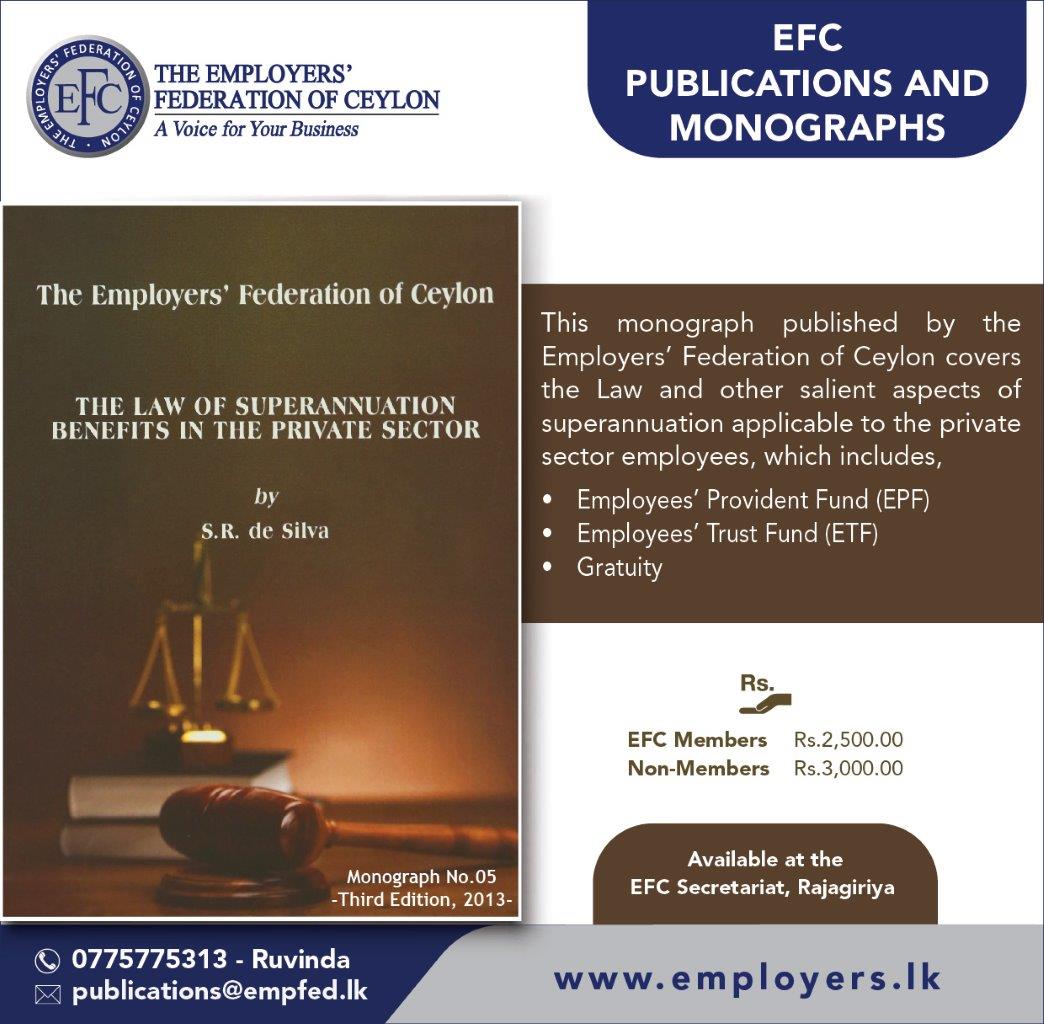
Books on Labour Laws, Industrial Relations and HR

NICC - Alumina

Banner
Banner